Anúncios
How to tell a real government benefit apart from a promotion dressed up as one.
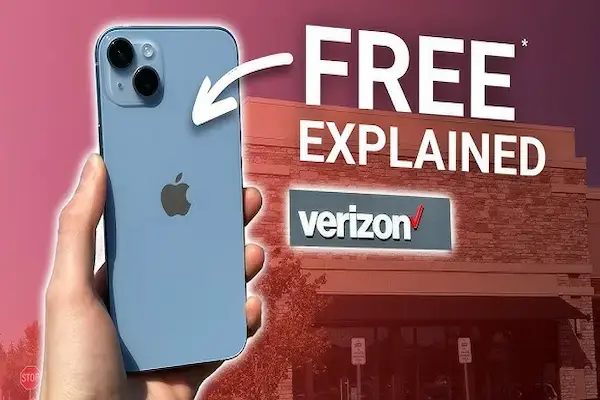
The word free shows up in both, and that single word is where most families lose money..
What people are really looking for when they type free iphone verizon
Search that phrase and two very different worlds show up on the same screen.
One is a carrier promotion with device credits spread across three years of billing.
The other is a federal program that lowers what you pay for service every month.
Both use the word free, and that single word is where most families get lost.
Knowing which one you are looking at changes what you sign, what you owe, and what happens if you leave.
Carrier promotion or government benefit
A carrier promotion is a sales offer. It belongs to the company running it.
It usually asks for a new line, a qualifying plan, and a commitment that lasts long enough for the credits to finish.
A government benefit belongs to you, not to a brand. It follows federal rules and it moves with you between participating providers.
So a free iphone verizon headline can be honest and still have nothing to do with government help.
Where Verizon fits into the Lifeline picture
Verizon does take part in Lifeline, but not in the same shape everywhere.
In some states the benefit shows up on home services rather than on a wireless line.
In others, wireless Lifeline is simply not offered, even though the brand operates there.
That is why two neighbors in different states can get two different answers from the same company.
Check availability by address before you build a plan around any single carrier.
And if the answer is no, the benefit still travels. It belongs to your household, not to Verizon.
Free phone plans and free phone deals: how to read them before you commit
Most free phone deals are built the same way, no matter which logo sits at the top of the page.
The device is billed at full price, then a monthly credit cancels part of that bill.
Miss a payment, downgrade the plan, or leave early, and the remaining credits stop.
That is why free phone plans deserve three specific questions before anything else.
Ask how many months of credits there are. Ask which plan keeps them alive. Ask what you owe if you cancel in month ten.
Phone plans with free phones and the long billing tail
Phone plans with free phones tend to look cheapest in the first month and heaviest in the twelfth.
Taxes, activation, and a required upgrade tier are rarely part of the headline number.
Add those up across a year and the free device often costs more than a used model bought outright.
None of that makes the offer a scam. It just makes it a purchase, not a gift.
Switch and get a free phone: what the carrier is really paying
Offers built around switch and get a free phone all run on the same mechanic.
The carrier wants a line pulled away from a competitor, so it pays for that line over time.
Payment usually arrives as bill credits, sometimes as a prepaid card, almost never as a free device on day one.
There is also a rule people miss: your old line generally has to be active when you port it over.
Cancel first and the offer can disappear before you finish the paperwork.
The full breakdown of how those credits are paid out, and what cancels them, is in our guide on carrier switch offers.
Free iphone with new service: the trade you are agreeing to
Free iphone with new service means the phone is tied to a plan you agreed to keep.
The value is real, and for some households it is the right call.
Just be clear that you are trading flexibility for hardware.
If money is tight this year, locking a higher monthly plan to get a nicer phone can backfire fast.
Free mobile service through Lifeline: the part that really is free
Lifeline is the federal program that lowers the cost of phone or internet service for low income households.
It has existed for decades and it is overseen by the Federal Communications Commission.
The benefit is a discount of up to $9.25 per month on your phone or internet bill.
Households on Tribal lands can receive up to $34.25 per month.
Many providers build their entry plan around that amount, which is why people describe it as free mobile service.
The program discounts service. It does not promise any particular handset, and it never promises an iPhone.
Who the program is built for
- Households enrolled in Medicaid, SNAP, SSI, or Federal Public Housing Assistance
- Households receiving a Veterans Pension or a Survivors Benefit
- Households in certain Tribal assistance programs
- Households with income at or below 135% of the Federal Poverty Level
One qualifying item is enough. You do not need to check every box on that list.
Proof is what turns eligibility into approval, so gather it before you start typing.
An award letter, a benefit statement, or a recent pay stub usually covers it.
Government free sim: what actually shows up in the mail
There is no separate government SIM card sold or issued by any federal agency.
What people call a government free sim is the starter kit a participating provider sends once you are approved.
Sometimes it arrives by mail, sometimes you pick it up in a store, sometimes it is an eSIM profile you scan.
Ask which type your provider uses, because an older handset may not support eSIM at all.
The card is only the key to the door. The monthly discount is the thing that has value.
How to apply for Lifeline step by step
The paperwork is lighter than most people expect once it is broken into pieces.
- Confirm which program you are enrolled in, or gather proof of household income.
- Apply through the official portal at LifelineSupport.org, which runs the National Verifier.
- Upload your proof documents in the same sitting so the file does not sit incomplete.
- Wait for approval, then choose a participating provider that has coverage where you live.
- Activate the line and save the confirmation email or a screenshot of the plan details.
Approval comes before the provider choice, and that order matters.
Picking a company first is how people end up on a plan that never had the benefit attached.
Free phone service with EBT: how SNAP opens the door
EBT is the card, not the program behind it.
When someone says free phone service with EBT, they usually mean their household receives SNAP.
SNAP is one of the qualifying programs, so that enrollment can carry you straight into Lifeline.
Bring the SNAP award letter or benefit statement as proof, not the plastic card itself.
Cell phones for seniors and the one benefit per household rule
Lifeline allows one benefit per household, not one per person.
That single rule causes most of the confusion in multi generation homes.
If a parent lives with adult children and everyone shares money, that is normally one household.
If people live under the same roof but keep separate finances, separate households can exist under the rules.
When the situation is unclear, a household worksheet settles it during the application.
For an older relative, pick the simplest handset they will actually use and set up emergency contacts on day one.
Government home phone service and government landline home phone service
Not every household wants the benefit on a cell line.
Searches for government home phone service and government landline home phone service come from real needs.
Medical alert equipment, a fixed line during outages, and older relatives who never adapted to a smartphone all count.
The Lifeline discount can be applied to a wireline home phone instead of a mobile plan, depending on what is offered near you.
That is also the honest answer behind free landline phone for low income searches.
You still get one benefit, so choose the line the household depends on most.
Ask the provider whether the home option is available at your exact address, not just in your state.
Wireline coverage can stop a few blocks from a neighbor who was approved without any trouble.
If the home line is not offered near you, moving the benefit to a mobile plan is usually the faster fix.
Free phones no contract and free phone service programs worth checking
Free phones no contract is a fair expectation inside Lifeline, since the benefit is not a sales agreement.
Free phone service programs outside Lifeline do exist, and they vary a lot by state and by carrier.
- State level assistance funds that stack on top of the federal discount in some regions
- Provider donation and refurbished device programs run through local nonprofits
- Community and library programs that hand out devices to students and job seekers
Any of these can be legitimate. Verify participation through official channels before you send documents.
Government phone t mobile and government phone data: what to confirm
Brand names change hands and program participation changes with them.
A government phone t mobile result today may point to a subsidiary, a partner brand, or an old page nobody updated.
Confirm current participation with the provider and with the official Lifeline company lookup for your ZIP code.
Then look at government phone data specifically, because plans differ far more on data than on minutes.
If job applications, telehealth, or schoolwork run through the phone, a low data cap will hurt within days.
Ask about hotspot rules too, since many low cost plans block tethering entirely.
Who to call when the application gets stuck
Some steps are easier to finish with a person on the line than with a form on a screen.
A document keeps getting rejected, an address will not validate, or the household question has no obvious answer.
For anything about eligibility, the file itself, or recertification, the Lifeline Support Center is the right place to start.
For anything about the plan, the SIM, or coverage, the provider handles it and Lifeline cannot help.
Knowing which of the two owns your problem saves an afternoon of transfers.
Write down a reference number every time you speak to someone, on either side.
If a second call becomes necessary, that number is what keeps you from starting over.
Textnow plans, u mobile free phone and poptox call as fallbacks
Some households will not qualify, and that is worth planning for instead of ignoring.
App based services keep you reachable using wifi when a full plan is out of reach.
Textnow plans give you a working number with calling over wifi and a paid tier when you need cellular data.
A poptox call runs from a browser and can cover an occasional call without any app at all.
Names like u mobile free phone show up in the same searches, so check whether the offer applies in your country before you spend time on it.
None of these replace a real line, but they keep a number attached to your name while you sort out the rest.
Free government phone sign up online without getting burned
Signing up online is the practical choice when time and transportation are short.
It is also the format scammers copy most closely, because a landing page costs them almost nothing.
Paid ads sitting above the real results are where most people take the wrong turn.
Work in a fixed order and the risk drops sharply: eligibility first, provider second, activation last.
Run eligibility on the official portal, then bring that approval to a company you already confirmed serves your ZIP code.
If a page wants your documents before it will even tell you which carrier is behind it, that page is collecting leads, not applications.
Buying a used iPhone instead: the quiet strategy that works
Plenty of families end up with an iPhone without any device promotion at all.
They cut the monthly bill first with Lifeline, then buy a secondhand handset once the budget loosens.
It is slower than a headline promising a phone today, and far more reliable.
Three checks separate a good used iPhone from an expensive mistake.
- Make sure the device is not activation locked to a previous owner, or it will never turn on for you
- Pick enough storage for the photos, documents, and apps your household actually keeps
- Look at battery health on older models, since a tired battery makes the phone useless by midday
Ask the seller to power the phone on and open the settings screen in front of you.
Thirty seconds of checking there prevents most of the regret that follows these purchases.
Red flags on any free iphone page
- The page promises a specific premium device and never mentions eligibility rules
- A form asks for a Social Security number before explaining who the provider is
- There is no company name anywhere, only government wording and a countdown
- You are asked to pay a fee to release, unlock, or reserve the phone
Real programs explain their limits. Sales pages hide them.
Any request for payment to unlock a free benefit is your signal to close the tab.
A ten minute checklist before you sign anything
- Write down the qualifying program your household is enrolled in.
- Decide whether the benefit should sit on a mobile line or a home line.
- Decide whether you are keeping your current iPhone or replacing it.
- Check coverage and data limits for each provider available at your address.
- Save every confirmation, reference number, and screenshot in one folder.
Ten minutes of preparation removes most of the stress from the application itself.
If you already own an iPhone, keeping it and cutting the monthly bill is usually the steadier path.
The device is replaceable. The monthly cost is what decides whether you stay connected next year.
A phone number on a job application, a call to a clinic, a way to reach your family at night. That is what this benefit protects.
Nobody hands it to you automatically, and nobody will call to remind you it exists.
The only step that matters today is the eligibility check, and it costs nothing to run.
Lifeline is administered by USAC under FCC oversight. One benefit per household. Annual recertification is required.